Talk to us
Videocast
What it means to be an AI-first company
Many companies call themselves AI-first after rolling out AI tools. Redeploy CEO Risto Lavett explains why Redeploy built a 12-month program instead, with six tracks, owners, milestones and measurements.

Risto Lavett
,
CEO
October 8, 2026
Read the transcript
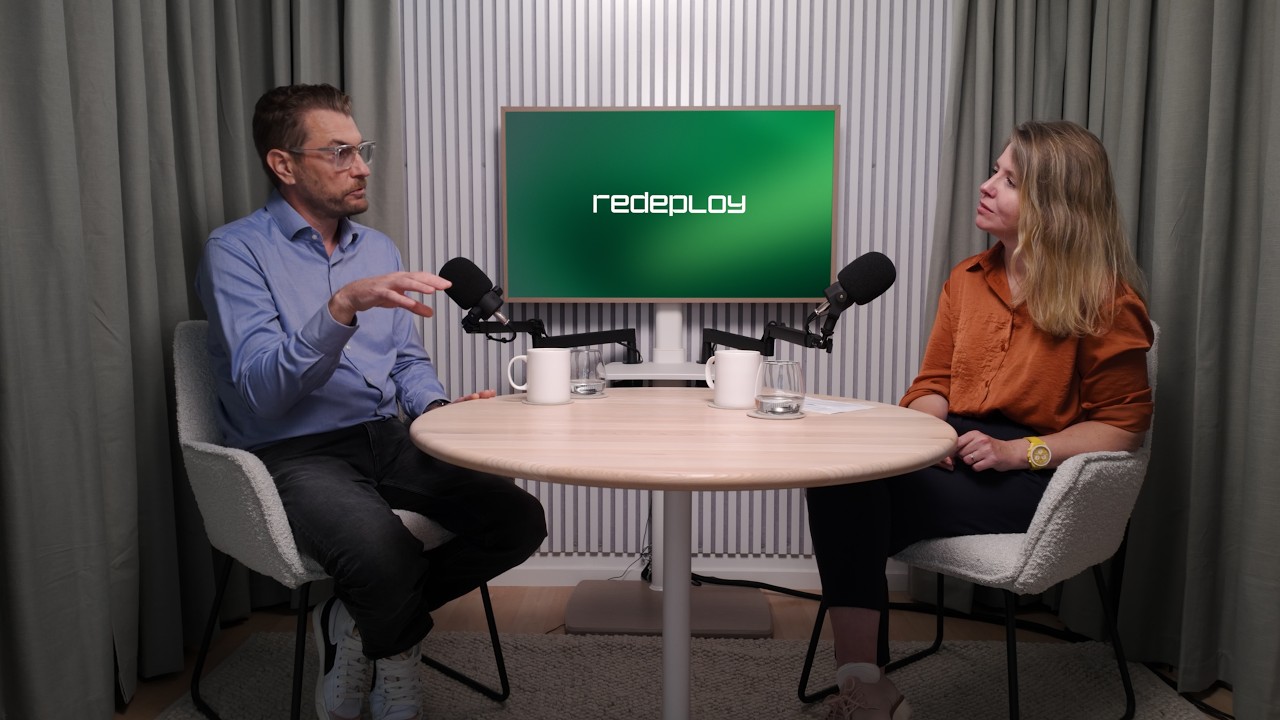
00:00 Emelie Fågelstedt“We are now an AI-first company.” We’re hearing a lot of CEOs and executives talking like that right now. They rolled out AI tools. But what happens next? My name is Emelie Fågelstedt, and I am an AI and innovation consultant. Today I’m here with Risto Lavett, the CEO of Redeploy. We’re here to talk about what it actually means to be an AI-first company, what it means to be agent-ready, and why maybe most enterprises still aren’t. With that said, Risto, nice to have you here in the studio.
00:35 Risto LavettThank you very much.
00:36 Emelie FågelstedtSo, AI-first. What does it mean?
00:40 Risto LavettGood question. Our definition is how we work and operate on a daily basis. It can be for you as a person within your role, and it can be how we deliver to our customers. It also differs from role to role. But the quick answer is how you work and use AI.
01:03 Emelie FågelstedtAnd you went out at Redeploy and told everyone that we’re now AI-first.
01:11 Risto LavettThat’s the easy way out, having the big town hall and saying, “Now we’re an AI-first company.” I think the hard part, and what we actually did, was creating a program around it. So defining AI-first, communicating a lot about it so everyone understands and gets the buy-in, but also having owners attached to milestones and measurements. We have six tracks covering how we deliver, how we work, and how we’re going to educate everyone. And then we have a timeline saying, okay, we need to meet these targets by this milestone, and then we have an end date for the whole program. I think that’s the different part of how we’ve done it.
01:58 Emelie FågelstedtAre you becoming AI-first just because it’s a buzzword, or do you actually see that there’s real value in starting to work and act more like this as an organization?
02:07 Risto LavettWe’re coming from being a tech company. We’ve always worked with cloud, data and AI. So it’s important for us to live as we learn. If we don’t live and breathe and work according to this, we’re not credible. It would be easiest to slap “AI-first company” on it. But I really wanted to involve everyone, from me, the CEO, to the CFO to HR, so that all of us are AI fluent.
02:41 Emelie FågelstedtAs you’re saying, you help other companies navigate these AI changes, also with cloud and data. Is it different to work with change in the culture internally compared to what you deliver to your clients when you try to help them with this?
02:57 Risto LavettThere is a lot of fear and thoughts around AI on several levels. When we go in and deliver solutions to our customers, which nowadays are AI-powered all the time, we have a proper scope, a proper value, a proper project. I would say that’s easier than changing how you work, or how you operate your workflows daily. So in a lot of parts, yes, it’s harder.
03:35 Emelie FågelstedtWhat has actually changed in the day-to-day work at Redeploy?
03:40 Risto LavettFor non-engineers, like our CFO Rikard, I like to take him as an example. He didn’t work so much with AI before, but seeing what he could utilize in figures and Excel, and how he could automate workflows and reports, has changed his work dramatically. And we have big projects where we have engineers, but also project managers and analysts. Having them work with AI within projects, with our own developed skills, from start to finish, involving AI and connecting it, has changed a lot in our delivery to customers too.
04:32 Emelie FågelstedtBecause I imagine there’s a shift. There’s a difference between saying we have this culture where AI is our first approach, and just saying, “Everyone at the company, here you go, you get a Claude license, go crazy and do things.” Why is the way you’re doing it different from just handing out licenses to all employees?
04:53 Risto LavettWhen we started this journey with a program, about 95% of our employees used AI in their daily work. So everyone basically uses AI as a tool. That’s nothing new. Where our AI-first program differs is actually implementing AI in every workflow, or removing stuff. How can we make this better? Do we really need this system? Can we connect this data and create skills around our competence so everyone can utilize it? My big aim for the future is having the operating system of the company, the Redeploy operating system, connecting all the data and making it available for everyone. My big vision is to have AI as an engine, and then an interface for everyone to utilize.
05:53 Emelie FågelstedtWhen you have different competencies and different teams, it’s quite common that, for instance, the development team works in silos with their things, and the finance team does something else.
06:06 Risto LavettYeah.
06:06 Emelie FågelstedtAre you actually getting them to speak with each other and share their knowledge?
06:10 Risto LavettAbsolutely. One example is Christoffer, our head of marketing. He has developed a marketing skill and also a design system. So you can use Claude and just create presentations according to our design system, and create the PowerPoint or whatever graphic design you need. It becomes an extension of him. So you don’t need his or other skills to do the marketing. That’s one example. But also in projects, absolutely. We work in the same project, we update Confluence, we’re connected to GitHub. So in deliveries we’re working together, also with AI.
06:55 Emelie FågelstedtIf everyone gets access to the same tools and the same skills, does everyone become an AI engineer of sorts, or do they still work differently?
07:06 Risto LavettThat’s been one of the questions we got in the beginning: “I’m a cloud engineer. Do you expect me to be an AI engineer when we’re finished with this project?” We have defined this very thoroughly per competence team. We have cloud engineering as a competence team, for example, and AI engineering as a team. We also have strategy as a competence team, and the definition of AI fluent in the strategy team is very different from the definition in the engineering team. There’s a higher bar and higher competence around AI, what you should know and how you should work, in that team compared to the strategy team. So we have defined it according to your competence, and we’re not expecting everyone to become AI engineers.
07:56 Emelie FågelstedtWhen we talk about employees or colleagues, would you say that your relationship to these tools right now is that you’re using the agents as part of the team? So they’re almost like colleagues?
08:10 Risto LavettI think there’s a lot of governance and human in the loop, so you cannot fully trust the agent as a colleague. I think we’re getting there. It’s absolutely a colleague that, under supervision, is part of the team. But comparing the agent to a human colleague, I wouldn’t do that. As a junior, helpful one, absolutely.
08:44 Emelie FågelstedtI’ve seen some companies say, “We had a headcount of 100, but now we are 1,500,” because they start counting their agents as part of their team.
08:57 Risto LavettYeah.
08:58 Emelie FågelstedtDo you think that’s a future we’re heading towards?
09:02 Risto LavettThe AI hype has been a journey of sorts, where the big point was using AI to cut costs and cut people. I think focusing solely on that was a mistake, because I don’t think that’s true. We’re faster, we’re better at doing stuff. But it has also created more work. It hasn’t created less work, and it hasn’t created less complexity. It has just added more. So it’s really important to protect people and define what your colleagues should work on, so they don’t get overwhelmed and just keep on token maxing and working. But developers shouldn’t be afraid for their work. If they adapt and are smart, there will absolutely be work for them in the future.
10:00 Emelie FågelstedtWhen we started talking about AI, all the focus was on the tech, the tools, the different organizations bringing these models out. But it seems that becoming AI-first is just as much a people question.
10:15 Risto Lavett100%. Hopefully in our company we’ve passed the fear curve and moved into, “Oh, this is good for me. I can utilize this in my day-to-day work, I can be more effective, I can do the stuff I don’t really want to do by supervising the agent doing the dirty work, and I can do the fun part.”
10:41 Emelie FågelstedtYou’re bringing up another important question. When all these tools and the whole hype started, everyone was saying we’ll be so much more productive and efficient, we can work less. Instead the opposite has happened to a lot of people. Reports show they’re actually working more, because they can do more, and then they get handed more things to do, or they just keep on doing things and work more hours instead of fewer.
11:07 Risto LavettYeah.
11:08 Emelie FågelstedtHow do you go about managing and making sure that doesn’t happen at Redeploy?
11:14 Risto LavettOne important part is when we work with our customers, because we’re pretty much a consultancy firm doing projects for our customers. The scoping is really important. What do you want us to do? What value should we bring? What should it cost? And when are we done? If you don’t scope that at an early stage, it’s really easy to get into scope creep, where the customer expects more and more and you’re never done. So that’s an important part when working with our clients: be clear on the scope and what you want us to do. Then you can work in phases: this is the first delivery, this is the second, this is the third. Internally, you also need to set your own boundaries. You get a kick out of it. When you work with AI it never stops, it can create more and more, better and better. So you need to put a limit on yourself somewhere: okay, now I’m done, now I need to do something else. You need to put limits and scope on yourself.
12:30 Emelie FågelstedtI guess. Sometimes I’m like, okay, I’m so up to date now, I know what’s going on. And then all of a sudden you see new reports, some new term, some new tool or something else you’re supposed to do. Does this not stress people out? As you’re saying, you pride yourselves on being at the very edge of technological development. So how do you find a pace and ensure you’re learning the right things when there’s so much going on in this space?
13:02 Risto LavettI think everyone has that problem, so it’s not unique to us. But again, it’s about setting the right expectations. You are not supposed to know everything. Even if you have AI, you still have your role, your job and your goals. You can’t expect to know ten times more just because you have AI. I don’t think that’s reasonable. So set those expectations from the management level and say, okay, we understand it can be stressful, but we don’t expect ten times more knowledge from you. It’s important not to have those high expectations just because you have the AI tools or a way of working.
13:53 Emelie FågelstedtA lot of CEOs and management teams are struggling with that. They go out and say, okay, now we’re AI-first. But then what do you as an employer actually owe your team when it comes to setting the right expectations?
14:07 Risto LavettThat’s a really important part, and where it can go wrong: just expecting everyone to do something. An important part for us is being very communicative about what it is and what you should do, having leaders and a clear definition of done in each track. Okay, I’m part of the cloud engineering team, I have these colleagues, I should take these courses and these tests in this track. Having clarity, direction and goals is really important. Within that you know, okay, this is what I’m supposed to know and learn within this time frame. Then it’s very clear.
15:01 Emelie FågelstedtIf we go back to this whole term of being AI-first again: if you speak with another CEO who says, “We’re going to be AI-first,” what’s the first thing they need to do to make sure they’re on the right path?
15:19 Risto LavettDefining what it is for you, because you can define it a little how you want, but also for the size of your company. We’re a company of around 100 people.
15:27 Emelie FågelstedtYeah.
15:30 Risto LavettAnd we have supporting functions. We are not only engineers in our company, but they’re the majority. You should get everyone on board, as I said, from the CEO to the CFO to recruiters or whoever. Not only the engineers. This is not only an engineering thing. So get everyone on board, set the baseline, set goals and define what it is. And then, for my part, creating a program is key. This is such a big shift, such a big change in the industry and for us. It really needs to be done in a proper way to work in practice. This defines everything around our company and how we work. So it’s important to set the definition, run a program, have owners and have measurable outcomes.
16:24 Emelie FågelstedtI’m assuming it’s not always easy to start out on this journey, even if you have a plan, a program and a strategy. What did you underestimate? What was harder than you thought it would be?
16:38 Risto LavettI’m a time optimist and I want to get stuff done fast. But this was such a big shift for us, and I think for the business in general. We decided quite early to make a program for this. But time was one of our misestimations. In the beginning we thought, okay, we can do this in three months or half a year. But the program is 12 months, and we’re on track now. So don’t underestimate time.
17:07 Emelie FågelstedtBut 12 months, you’ve encapsulated it into a one-year thing. Do you think that’s true for other organizations too? Is 12 months how long it will take?
17:19 Risto LavettNo, I think it depends on size, where you’re at at the moment and what you’re doing. We’re a tech company where the majority of our colleagues are engineers, but we also have supporting functions like the CFO and recruitment. So it depends. No is the short answer. It can take three months, it can take two years, depending on the size, where you start and what you do.
17:50 Emelie FågelstedtSo from one learning CEO to another, what advice would you give on how to get started and make this a real thing?
17:59 Risto LavettPut in the prep work and involve the company. Don’t just make it a management exercise. Go and create a strategy and create the plan in management, absolutely. But then involve the organization and have feedback loops, so you can test it and see that it’s viable. Involve them at an early stage, and also involve them in defining the content and the definition of done, because they’re the ones who are going to do the actual work. So involve them early.
18:42 Emelie FågelstedtDo you think it’s also smart for companies to share experiences with each other?
18:47 Risto LavettAbsolutely. One thing we’re doing, which is really good, is round tables with current customers and non-customers. We invite people to discuss, a lot of the time AI of course, since that’s a hot topic in different fields, but also to discuss experiences, what they’re doing, and learn from each other. I think that’s really important.
19:14 Emelie FågelstedtAnd if people want to learn from you, is that okay?
19:17 Risto LavettAbsolutely. You can contact me and call me. I don’t know everything, as I said. I think I know some, but my colleagues know a lot more. But yes, absolutely, you can start with me.
19:29 Emelie FågelstedtSounds awesome. Well, best of luck on completing this 12-month program.
19:33 Risto LavettThank you.
19:34 Emelie FågelstedtThank you for being part of this conversation.
Want to compare notes?
Tell us what you are working on and we will connect you with the right person at Redeploy.
Book a conversation



Thank you!
Your submission has been sent
Your submission has been sent
Oops! Something went wrong while submitting the form. Try mailing us at info@redeploy.com instead!