Talk to us
Picking Brains · Vol.
10
“The unglamorous engineering is what gets it into production”
Ivan Chernukha, AI Engineer at Redeploy, on why so little of AI work is about the model, and what it takes to get a solution into production.

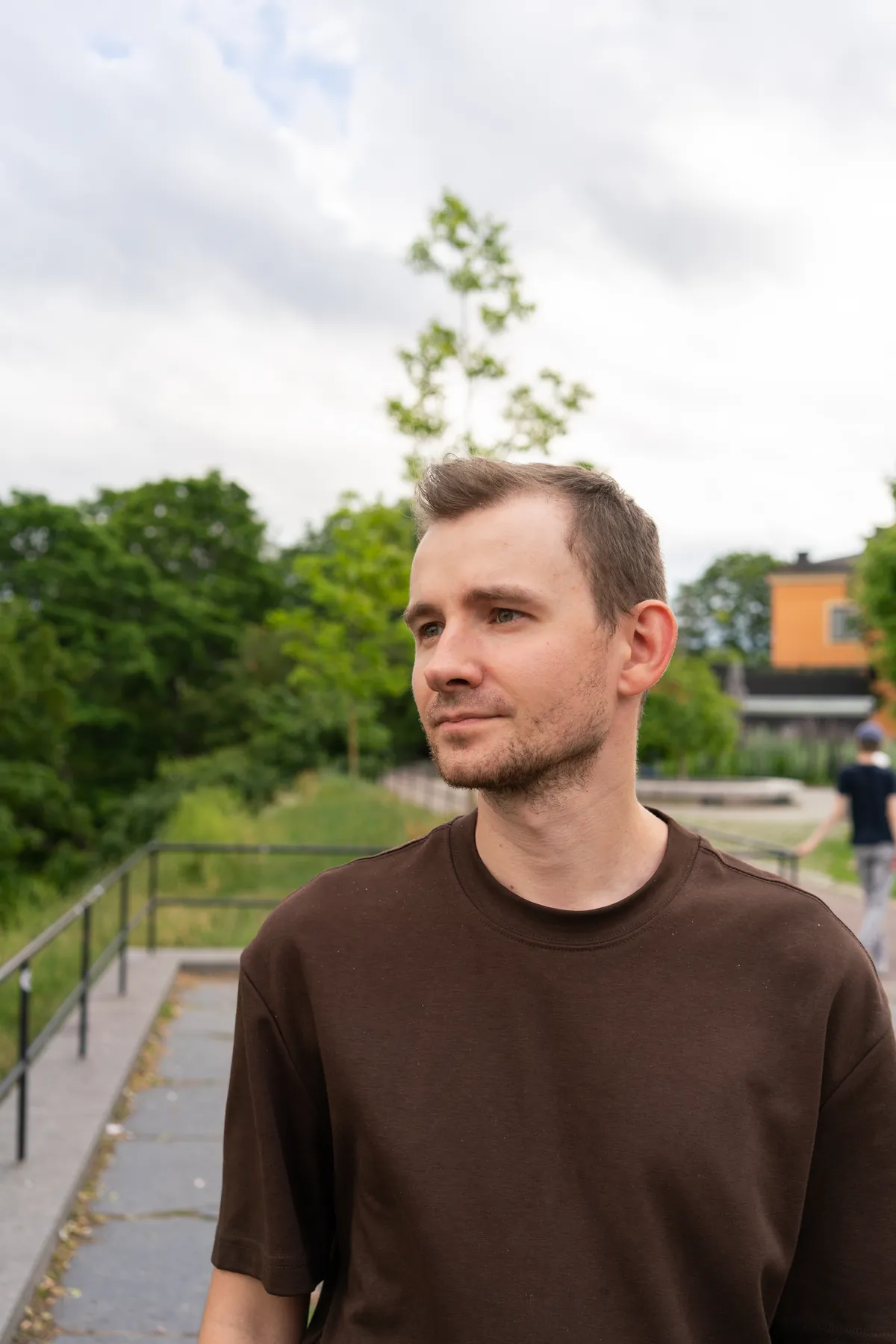
Ivan started in software engineering, spent years in computer vision research and worked his way back to engineering when LLMs arrived. Today he builds AI that people use every day.
Picking Brains is our interview series with the people who build Redeploy's platforms. In volume 10 we met Ivan for coffee and a walk in Stockholm. We talked about AI for a regulated bank, why accuracy is a tricky metric, and the one thing to agree on before you start.
What path led you into AI engineering?
I started in software engineering, then moved into machine learning and computer vision research, including autonomous vehicles. But research is solitary, and you rarely see your work turn tangible. So I worked back toward engineering, via data science and MLOps. When LLMs arrived, the problems AI could solve exploded, and that's where I wanted to be.
What's the part of the work that still keeps you hooked?
Seeing work become genuinely more efficient. Automate the boring, repetitive parts of a job and you free up space for something more creative and challenging. For me it was never about the hype or the model, but about knowing where AI actually fits, where it doesn't, and where it would only waste resources.


Measuring AI
“I'm wary of 'accuracy' as a metric to measure AI. It sounds precise, but two experts can grade the same answer differently.”
Ivan Chernukha
AI engineer
A project you're proud of, and what it changed?
I recently worked with a major Swedish bank on a RAG application for regulatory compliance, answering questions against their internal knowledge base, like how loans get issued. We built it specifically for them and shipped it. Around 3,000 people now use it daily and get reliable answers far faster.
What has surprised you in your role?
How little of the work is actually about the model. Data science was once called the sexiest job, but tuning a model rarely solves the real problem. The unglamorous engineering is what gets it into production. The other surprise is expectations: people assume a use case that works in Sweden transfers straight to other markets, facing completely new processes.
Fact box
What is RAG?
Retrieval-augmented generation, or RAG, lets an AI model answer questions using an organization's own documents. It's a common fit for questions on policy and regulations against an internal knowledge base. If we take the example of Microsoft Azure, a RAG solution is typically built with Azure OpenAI for the model, Azure AI Search to find the right content and Microsoft Foundry to build and run it.

Before you start
“Agree on a definition of done before you start, or scope creep wins.”
Ivan Chernukha
AI engineer

What's your take away advice when implementing AI?
Agree on a definition of done before you start, or scope creep wins, because in engineering there's always one more thing to improve. With AI it's harder, since results are hard and expensive to measure, so decide what 'good' means up front.
What it means for your organization
Ivan's advice is easy to say and hard to follow. Decide what done and good mean before you build, because AI results are expensive to measure afterwards. Then put the effort where the work really is: the engineering around the model.
For AI that answers from your own knowledge base on Microsoft Azure, the building blocks are typically Azure OpenAI for the model, Azure AI Search for finding the right content and Microsoft Foundry to build and run the solution.
AI Platform
Define done, then ship it
Ivan's advice starts with a definition of done. Our AI Platform is a secure foundation for taking AI from prototype to production.
Explore AI Platform